
Views: 0 Author: Site Editor Publish Time: 2026-11-10 Origin: Site


Scaling a complex cosmetic vision into a viable commercial product demands exceptional technical precision. Formulating an intricate 24-Shade Multi-Finish Eyeshadow Palette is a multifaceted engineering feat. You must view the selection of a capable custom makeup manufacturer as a critical strategic partnership rather than a routine procurement task. They provide the necessary lab capabilities to troubleshoot unique texture behaviors. Our core objective here is to highlight how brands successfully balance striking aesthetic payoff with structural integrity and strict regulatory compliance. We will dissect the science behind particle size, oil-absorption rates, and compression formulas. You will learn exactly how to vet production partners effectively. We also break down the step-by-step roadmap for turning raw pigments into a shelf-ready color story.
Pigment Engineering: Why particle size and oil-absorption profiles determine the difference between luxury-feel and chalky formulas.
Structural Optimization: The relationship between binder ratios, compression pressure, and long-term shelf stability in multi-finish pans.
Performance Metrics: Defining standardized testing for fallout, blendability, and color payoff across matte, shimmer, and metallic textures.
Manufacturer Vetting: Essential criteria for evaluating a custom makeup manufacturer’s production capacity and R&D precision.
Creating a stable Custom Eyeshadow Formula requires deep knowledge of raw cosmetic materials. Chemists primarily choose between organic dyes, mineral pigments, and synthetic micas. Organic dyes deliver incredibly bright, neon hues. However, they easily stain the skin if formulated poorly. Mineral pigments like iron oxides create highly stable, earthy tones. They provide excellent opacity but can feel dry. Synthetic micas offer a consistent, lab-controlled sparkle. They eliminate the heavy metal contamination risks often associated with naturally mined mica. We often blend these base materials to achieve complex, multidimensional shades. You must understand how these distinct particles interact inside the mixing drum. Poor material combinations inevitably lead to uneven color payoff.
Formulation requirements shift drastically depending on the desired finish. Mattes and shimmers require entirely different processing methods.
Matte Formulations: These shades are notoriously base-heavy. They rely heavily on powders like talc, mica, or silica. Chemists use high-shear mixing to disperse the pigments uniformly. Without aggressive mixing, mattes become streaky and chalky.
Shimmer Formulations: These shades are pearl-heavy. They demand extremely gentle folding during the manufacturing process. High-shear mixing destroys delicate pearl spheres. The powder loses its reflective properties instantly if over-mixed.
Metallic Formulations: Metallics use ultra-fine reflective particles bound by heavy liquid lipids. They require precise temperature control during pressing to achieve a foiled effect.
Bench samples serve as your absolute source of truth. Relying purely on digital color renderings guarantees disappointment. A skilled laboratory provides physical pre-production samples. You evaluate these samples in multiple lighting conditions. Natural daylight reveals undertones differently than harsh retail lighting. Pre-production calibration ensures the final mass-produced palette matches your initial brand vision. It also gives you the opportunity to test skin adhesion before committing to a massive production run. Skipping this calibration phase often results in costly mass-production errors.
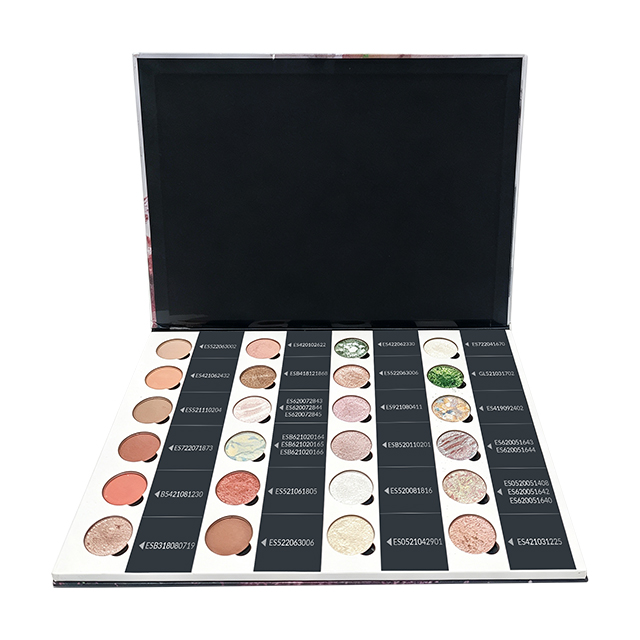
Binders are the liquid or dry adhesives holding your powder together. Common wet binders include dimethicone, jojoba oil, and synthetic waxes. Finding the precise binder-to-powder ratio is an exact science. Too much liquid binder creates the dreaded "hard-pan" effect. The surface of the eyeshadow seals off completely after a few uses. The user gets zero color payoff. Conversely, insufficient binder causes severe fallout and crumbling. The powder simply disintegrates upon contact with a brush. Formulators must adjust binder levels meticulously for every single shade in the palette. Darker pigments absorb more oil than lighter ones. Therefore, a uniform binder ratio across 24 different shades will fail.
Pressing eyeshadow involves specific mechanical pressure. We measure this in pounds per square inch (PSI). Controlled PSI is strictly critical for multi-finish palettes. Matte shades contain dry, jagged particles. They require high compression pressure to bond properly. Sometimes, factories press them at over 1,000 PSI. Shimmers and metallics behave differently. They contain soft, fragile pearl structures. Pressing them too hard crushes the pearls and ruins the sheen. Manufacturers usually press shimmers at much lower pressures, around 600 PSI. Specialized equipment adjusts the pressing force automatically for different pan rows. This targeted approach ensures uniform density across disparate textures.
You must constantly weigh aesthetic desires against physical reality. Consumers want "soft-touch" formulas featuring massive pigment payoff. However, overly soft formulas fail basic transit testing. We use the standard 30-inch drop test to evaluate structural durability. If an eyeshadow shatters upon impact, the formula is too soft. We then face a distinct trade-off. We can increase pressing strength to guarantee transport survival. Yet, doing so reduces the immediate color payoff. Experienced formulators solve this by introducing advanced dry binders like zinc stearate. They improve adhesion and durability without hardening the pan. This careful risk mitigation prevents thousands of damaged units during shipping.
In the competitive sector of Color Cosmetics, longevity dictates brand loyalty. Eyelids naturally produce high amounts of sebum. This natural oil breaks down powder pigments rapidly. We combat this degradation using specialized film-formers. Film-formers create a flexible, microscopic mesh over the skin. They lock the color firmly in place. This prevents creasing, fading, and migrating throughout the day. Water-resistant polymers also help repel sweat and humidity. A high-quality formula grips the eyelid smoothly without requiring an aggressive primer.
Cosmetics must survive harsh environmental shifts. Complex multi-shade configurations face unique stability challenges. We rely on rigorous stress testing protocols to validate shelf-life.
Thermal Cycling: We place samples in incubators alternating between freezing and 45°C (113°F). This mimics extreme shipping conditions.
Humidity Resistance: We expose the pans to 80% relative humidity. We observe them closely for mold growth or moisture absorption.
Light Fastness: UV chambers test how quickly the organic dyes fade under direct sunlight.
Syneresis Checks: We monitor the pans to ensure liquid binders do not bleed out over time.
Regulatory adherence is entirely non-negotiable. Different regions enforce drastically different safety standards. The EU Cosmetic Regulation currently bans over 1,600 chemical compounds. The US FDA maintains strict restrictions regarding specific colorants used near the eye area. For example, certain red lakes are prohibited for eye use in America. Evaluating your manufacturer’s compliance expertise prevents catastrophic recall risks. A reputable partner runs continuous microbiological testing. They screen for heavy metals like lead and arsenic. They also ensure every preservative system meets global safety thresholds. Ignoring the compliance gap ultimately destroys brand trust and invites legal action.
Not all cosmetic factories possess the same technical bandwidth. Some facilities specialize exclusively in cheap, high-volume mass production. They rely on stock formulas and reject heavy customization. Other factories offer the agile R&D support required for complex developments. You must audit their capabilities aggressively. Do they employ full-time cosmetic chemists? Do they own multi-ton pressing machines capable of variable PSI? Can they handle custom tooling for unique pan shapes? A comprehensive capability audit answers these vital questions. It separates true innovators from standard assembly houses.
Many brands start with a small pilot run. They need only 5,000 units initially. However, a viral product launch might demand 100,000 units the following month. You must determine if your partner can scale production without sacrificing formulation integrity. Scaling up is rarely linear. Mixing a 10-kilo batch of eyeshadow behaves differently than mixing a 500-kilo batch. Heat distribution changes. Shear forces alter. A top-tier manufacturer utilizes highly calibrated scale-up protocols. They ensure the millionth palette performs exactly like the first prototype. Ask potential partners about their batch-to-batch consistency metrics.
Total transparency separates professional manufacturers from unreliable vendors. You must demand full ingredient traceability. Every single raw material entering the facility needs documentation. Reliable partners provide complete Certificates of Analysis (COAs) for every batch produced. These documents prove the absence of harmful pathogens and verify pigment purity. You also need updated Material Safety Data Sheets (MSDS) for global shipping compliance.
Manufacturer Evaluation Checklist
Evaluation Criteria | Standard Assembly House | Agile R&D Partner |
|---|---|---|
Formulation Approach | White-label stock formulas only | Custom chemistry from scratch |
Pressing Technology | Fixed PSI pressing machines | Variable PSI for multi-textures |
Testing Capabilities | Basic visual inspection | Thermal, drop, and micro-testing |
Regulatory Support | Provides minimal documentation | Supplies full COAs and MSDS |
This phase turns a conceptual color story into a workable chemical matrix. You supply mood boards, benchmark products, and shade references. The chemists evaluate the feasibility of achieving these exact colors safely. They select the base powders, active pigments, and appropriate binders. They formulate initial lab dips for your approval. You evaluate these dips for color accuracy and basic skin feel. This phase often requires three to four revision cycles. Patience here is absolutely critical. Rushing formulation always results in inferior end products.
Once you approve the lab dips, we move into pilot testing. The manufacturer produces a small, controlled batch using actual factory equipment. This step validates texture dynamics and wear performance at a larger scale. We subject these pilot units to drop tests and thermal cycling. We also send them out for real-world user testing. Makeup artists test blendability, fallout, and crease resistance over an eight-hour period. If the pilot units fail any structural or wear tests, the chemists reformulate immediately. We never proceed to mass production until pilot units pass every single stress test.
This phase involves bulk manufacturing. The raw materials undergo aggressive weighing, milling, and mixing. Large industrial blenders disperse the pigments into the base powders evenly. Next, the loose powders move to the pressing lines. High-precision machines dispense exact gram weights into the metal pans. The automated press tamps down the powder using predetermined PSI settings. The factory implements strict climate control during this phase. High humidity in the facility ruins powder formulations instantly. Ensuring consistent environmental controls guarantees batch-to-batch uniformity.
The final phase focuses entirely on standardization. Quality assurance teams pull random samples from the assembly line continuously. They conduct standardized visual and tactile inspections. They check for pan adhesion, surface cracking, and color drift. They compare the mass-produced units directly against the approved pilot standard. Any unit displaying zero-point-one percent variation gets flagged and destroyed. The team also verifies the structural integrity of the secondary packaging. Only after passing these exhaustive checks does the palette receive clearance for global distribution.
Developing an elite multi-finish eyeshadow collection demands a delicate balance. You must merge cutting-edge R&D with precise structural engineering and robust manufacturing expertise. Successful palette development is inherently an iterative, highly scientific process. It heavily rewards meticulous technical scrutiny over aggressive cost-cutting. Skimping on binder quality or pressing precision invariably leads to product failure. We encourage brand stakeholders to prioritize supply chain partners with proven, highly technical track records. Seek out teams that understand particle dynamics and global compliance deeply. By respecting the chemical complexities involved, you guarantee a finished product that captivates consumers and sustains long-term market dominance.
A: Developing a fully custom palette generally requires six to nine months. The R&D formulation stage takes roughly eight weeks. Pilot testing and stability validation consume another eight to twelve weeks. Finally, mass production, pressing, and assembly require an additional eight weeks. Sourcing custom packaging can extend this timeline further.
A: We prevent fallout by optimizing the binder-to-powder ratio and utilizing ultra-finely milled base powders. Including dry binders like zinc stearate increases particle adhesion. Furthermore, applying the correct compression pressure during pressing forces the powder molecules to lock together tightly without creating a hard-pan surface.
A: Matte shades contain irregular, dry particles needing high pressure to bind cohesively. Metallic shades contain delicate pearl spheres and higher liquid lipid levels. Pressing metallics with extreme force crushes these reflective structures, dulling their shine. Lower pressure preserves their foiled, high-impact finish.
A: A credible manufacturer must supply Certificates of Analysis (COAs) verifying pigment purity and the absence of pathogens. They should provide Material Safety Data Sheets (MSDS) for shipping. They must also offer heavy metal testing results and documentation proving compliance with FDA and EU cosmetic guidelines.


